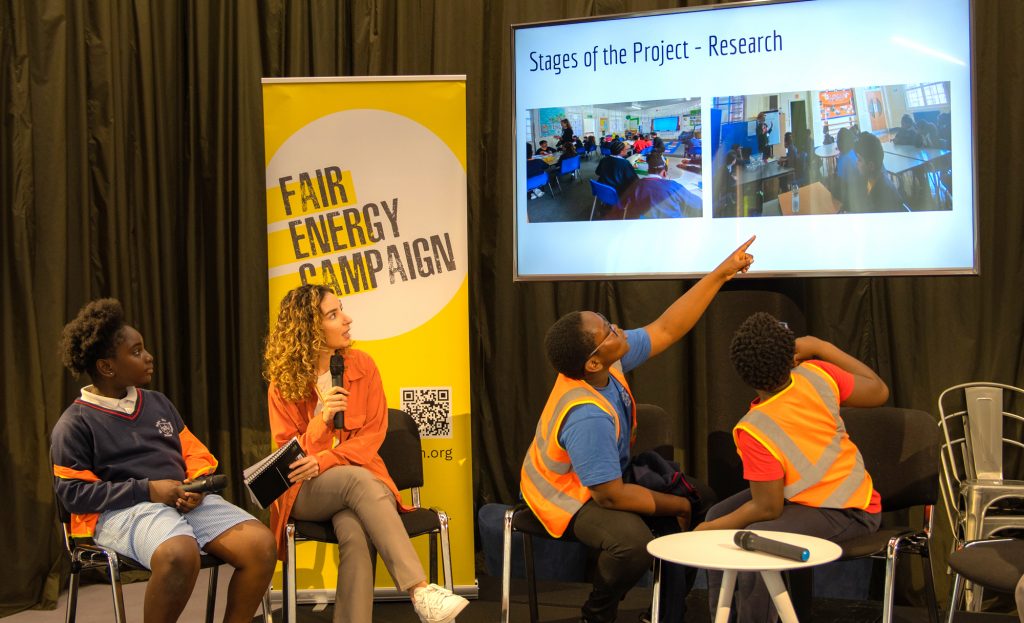
Working with St. John the Baptist primary school, Hoxton, we are developing a green wall prototype and curriculum to improve air quality in school and reduce CO2 emissions. We are also developing a methodology to document the reduction of energy usage through a collective action as school community.
Energy Education

During the Covid-19 pandemic, schools in London were given FloVent devices to measure air quality in and around schools to monitor air quality. Teachers and students at St John the Baptist school found out that the air quality measures at school are concerning. In 2021, their Sustainability Lead teacher, Candan Iscan, approached the Fair Energy Campaign to find a creative solution to reduce the level of CO2 and air pollution at school.
After our initial exploration of the positive impacts of plants on the living environment, we decided to explore green walls as a tool to learn about and improve air quality in school. We started by applying for funding to build a prototype, which gave us the possibility to measure the impact of plants on air quality in and around school, as well as to educate and empower children to take active care of the environment.
Over the course of a school term, we ran a series of workshops to explore air quality issues, co-design and build together a green wall with parents, children, teachers and a permaculturist. The Eco-warriors got to explore the issue of pollution and the effects on our health and learned about the importance and effect of plants on air quality.
Our GreenWall project engaged 200 primary school children in building their own ‘air purifiers’ for their classrooms, creating awareness, as well as measurable health and climate benefits.
To disseminate our methods, we developed a workbook and video resources, which are freely available through our website, to give as many schools as possible a chance to replicate the results that we have achieved. It explains step-by-step how to prepare, design and measure the impacts of green walls on the improvement of quality of life.
In the next phase, we will be exploring how we can reduce energy consumption as a school community through a series of exercises, led by school children themselves.
Climate change is becoming a big issue in the world and it is our responsibility as the teachers to equip children with the skills and the prospect that children can make changes could really improve the air they breathe community health and the planet.
– Candan Iscan, Sustainability Lead at St John the Baptist Primary School, Hackney, London